
We are lucky we live in the City of Yambol and have a village retreat, but anyone who has a home here knows that growing crops is a full time job from April onwards in Bulgaria. It is a sense of frustration that I can't be on the farm everyday tended to the crops, this was one of the biggest reasons for me coming to Bulgaria. Galia knows this and some wheels of motion were workng to get around this problem behind my back.
 It was an excited Galia in her sick bed today who finds it very hard to keep secrets and couldn't wait to tell me this one. The good life got better in the space of 10 seconds of the news being told. I tease you no longer as the news is we now we have the option of farming and growing crops in Yambol and not just on the village farm. Let me explain.
Although off sick from work at the moment Galia works as a floor manager in a boiler manufacturing company which happens to be owned by her elder brother. The factory is situated in an industrial part of the Yambol and has grounds alongside the big new factory of which part is set aside for farming. This is managed by some of the workers who get food as a reward for maintaining the farm.
Let me just put more detail of the situation as it stood up unitl today. All our farming is done in the Skalitsa village farmhouse some 35 kilometres away from Yambol and all through last year to now it had just been weekend farming. This was very difficult, near impossible to keep up with the extreme heat in the summer. Watering needs to be done at least every two days and in really hot weather every day, this wasn't possible last year. We managed to get some crops out of it, but it was a poor year with the system of weekends only. The retreat to relax after a hard week of work was seeing us work 100 mile an hour to catch up with the work that should be done each day, we ended up more tired on Monday morning than if we hasdnt' had the weekend retreat. Added to this the cost of fuel to and from the farmhouse just didn't make it an economic venture.
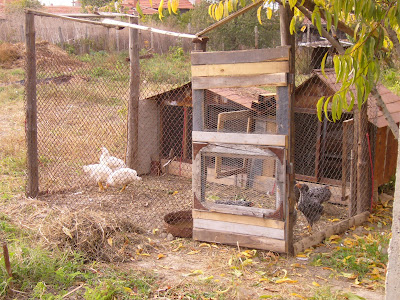 This year I had intended to stay there four days a week, but that would be on my own, Galia would have to pay taxi fares to work and back and still there would be a 70 kilometre round trip that had to be made once a week. Besides that there was the fact I wouldn't see much of Galia.
So with this news, the answer to growing crops without expensive overheads and logistic problems seemed to be answered. What we would like is to start our livestock up again? I am at the factory every morning and evening dropping off and picking up Galia from work, so a little extra time there tending before my work starts would be totally practical. On paper it would work very well.
So, you can now see why I am excited, but at the same time apprehensive about leaving the farmhouse and letting it go to seed if this was taken up. I can see us being in Yambol full time if this does take place, not what I want, but work here in Yambol forces the issue. We just can't financially afford the fuel each week and not get crops to supplement our low income. Everyone is happy for us to be in Yambol and can't understand why I have such a great love for village life that has nothing to offer other than isolation. Every Bulgarian around me says it's not practical - They are dead right, it isn't practical seeing as there is now the opportunity to farm in the City. I count myself extremely lucky to be with such a kind and caring community and my yearning for village life I feel is a very small sacrifice to pay for this.
There is another bonus, perhaps now we have the chance to relax at weekends during the warmer weather rather than rushing around trying to play catch-up on the farm. This would also end the weekly disappointment and frustration that happened last year where we regularly found our neglected crops failing because they have been left for 5 days without water.
Right now there are just onion, garlic and the vines that are growing there, these don't need regular watering so they will be okay and the rest of the more senstive crop now are planned for the City farm. How lucky are we?
The bottom line is we can't afford to be sentimental here and reminded me of what someone mentioned to me the other day about living in Bulgaria, "Life in Bulgaria is not about living it's about surviving." This is very true and this is what we have to do to achieve that right now.
 It was an excited Galia in her sick bed today who finds it very hard to keep secrets and couldn't wait to tell me this one. The good life got better in the space of 10 seconds of the news being told. I tease you no longer as the news is we now we have the option of farming and growing crops in Yambol and not just on the village farm. Let me explain.
Although off sick from work at the moment Galia works as a floor manager in a boiler manufacturing company which happens to be owned by her elder brother. The factory is situated in an industrial part of the Yambol and has grounds alongside the big new factory of which part is set aside for farming. This is managed by some of the workers who get food as a reward for maintaining the farm.
Let me just put more detail of the situation as it stood up unitl today. All our farming is done in the Skalitsa village farmhouse some 35 kilometres away from Yambol and all through last year to now it had just been weekend farming. This was very difficult, near impossible to keep up with the extreme heat in the summer. Watering needs to be done at least every two days and in really hot weather every day, this wasn't possible last year. We managed to get some crops out of it, but it was a poor year with the system of weekends only. The retreat to relax after a hard week of work was seeing us work 100 mile an hour to catch up with the work that should be done each day, we ended up more tired on Monday morning than if we hasdnt' had the weekend retreat. Added to this the cost of fuel to and from the farmhouse just didn't make it an economic venture.
 This year I had intended to stay there four days a week, but that would be on my own, Galia would have to pay taxi fares to work and back and still there would be a 70 kilometre round trip that had to be made once a week. Besides that there was the fact I wouldn't see much of Galia.
So with this news, the answer to growing crops without expensive overheads and logistic problems seemed to be answered. What we would like is to start our livestock up again? I am at the factory every morning and evening dropping off and picking up Galia from work, so a little extra time there tending before my work starts would be totally practical. On paper it would work very well.
So, you can now see why I am excited, but at the same time apprehensive about leaving the farmhouse and letting it go to seed if this was taken up. I can see us being in Yambol full time if this does take place, not what I want, but work here in Yambol forces the issue. We just can't financially afford the fuel each week and not get crops to supplement our low income. Everyone is happy for us to be in Yambol and can't understand why I have such a great love for village life that has nothing to offer other than isolation. Every Bulgarian around me says it's not practical - They are dead right, it isn't practical seeing as there is now the opportunity to farm in the City. I count myself extremely lucky to be with such a kind and caring community and my yearning for village life I feel is a very small sacrifice to pay for this.
There is another bonus, perhaps now we have the chance to relax at weekends during the warmer weather rather than rushing around trying to play catch-up on the farm. This would also end the weekly disappointment and frustration that happened last year where we regularly found our neglected crops failing because they have been left for 5 days without water.
Right now there are just onion, garlic and the vines that are growing there, these don't need regular watering so they will be okay and the rest of the more senstive crop now are planned for the City farm. How lucky are we?
The bottom line is we can't afford to be sentimental here and reminded me of what someone mentioned to me the other day about living in Bulgaria, "Life in Bulgaria is not about living it's about surviving." This is very true and this is what we have to do to achieve that right now.

