Amazing Cures From The Skalitsa Healing Stones Again

Amazing Cures From The Skalitsa Healing Stones AgainAnother couple of special events happened last weekend as I took more guests to the healing stones of Skalitsa. I had one guest staying in my farmhouse and another, a friend from England who had come over just to relax based in a Yambol hotel for a couple of weeks. I decided to show them the powers of the Skalitsa healing stones the first time as I was going the farmhouse to check up and water the crops.

The guest in the farmhouse tagged along as she was very curious and had heard lots of reports both on the Internet when researching about Bulgaria and from local people in the village who she was mixing with staying there. Unfortunately she wasn’t doused with any pain and her trip there was purely for the fantastic views and wide-open space it gave of the surrounding Thracian countryside with the Balkan mountain range in the distance.

My friend had constant back pain and was quite dubious about anything changing that with a visit. He was certainly a big doubter regarding any cure that might come about and was even more sceptical after my accounts of previous cures that had transcended not just to me and previous guests I had taken there and cured, but to many Bulgarians that frequent the place with astounding results. Not only that, but he had just read my book, which had a chapter about the healing stones. He was of the opinion that my book was more fictional based than factual with my account.

I was quite glad I was going as well as I also was quite stiff and sore from all the manual work bending over tending to crops over the last few months. My last trip there cured my back pain after recovering from a slipping disc on recommendation from a Yambol doctor who always is open to alternative medicine. I knew my pains would subside with a spell on a Skalitsa healing stone as it had done so many times before.
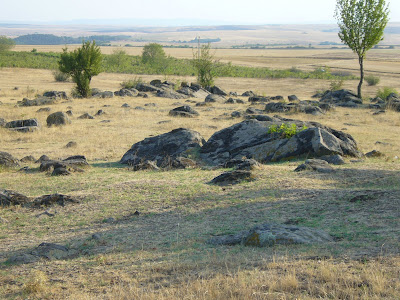
Amazing Cures From The Skalitsa Healing Stones AgainWe all lay for a while taking in the beautiful surround in the process and the talk led to telling the stories of aliens had been seen in Skalitsa in recent years and UFOs commonly seen in the area. Whether that may have had a bearing on the healing that affects was perhaps another angle on what causes the healing that happens here. In case you don’t know, this particular spot in Skalitsa has a phenomenon of being only one of two places in the world where two magnetic fields are crossed. The other one is in Mexico somewhere. It has been scientifically studied by scientists from Sofia and was confirmed as having positive affects for high blood pressure, headaches, rheumatism, arthritic joints and many other ailments and pains. It is not just hear say.

We spent around 30 minutes in the hot sun on the hot healing stones and as I expected as I sat into the Lada seat to drive back, all my aches had disappeared, I usually give a little moan as I bend to get seated to drive, that just didn’t happen. My friend was shocked, not from my cure of the aches and pains, but from his own experience now of his pains that were no longer there. He just couldn’t believe this had happened although the scepticism was still there from him as he said that the pain would probably return the next day.

The guest who had not ailments to cure said that she felt so much calmer by the experience and that she felt it gave ‘good vibes’ and a calming affect on her. She was a firm believer in alternative medicine in the first instance before the two old blokes had recovered from their pains.

The whole trip was a complete success – Again!

The conversion was now turned to talking business with the experience under the belts. The possibility of organising trips to the healing stones for tourists was the first one. Another other idea was to sell small samples of the healing stones online via eBay. Mmmm! All this talk about turning this village into a tourist spot and ridding it of its peace, quiet and natural unspoilt and untouched landscape was beginning to upset me a bit.

Amazing Cures From The Skalitsa Healing Stones AgainNow I put my hands up and own up to the fact that I do have some stones that I keep in our house in Skalitsa and Yambol from the spot. That’s one thing, but to make it into a big commercial enterprise is quite something else.

Amazing Cures From The Skalitsa Healing Stones AgainHowever there is the case where people should know about the Skalitsa healing stones and the cures it makes time and time again. It would benefit lots of people using this form of alternative medicine. If it does become more popular perhaps more might rent my farmhouse, which is only a ten-minute walk away.
Reblog this post [with Zemanta]

Very Busy But Bulgarian Food Still Rules!

Very Busy But Bulgarian Food Still Rules!What a busy couple of weeks! What a great couple of weeks, mainly getting stuck into growing crops and telling people about what it is like in Bulgaria rather than writing about it. My book has been selling really well recently as well and add funds from renting my farmhouse for a week to a decent respectful guest, it all adds up to being able to afford to change the oil in the Lada after three years! That’s how things work here for us living on a day-to-day basis. This busy time looks like continuing for sometime as the growing season moves up a couple of gears. I have said it before and will say it again, the food here grows faster than the pace of life.

Very Busy But Bulgarian Food Still Rules!Both farms are really doing well and we have had crops of potatoes and beans, which again were cooked by Baba direct from delivery. The bean and potato meal with whole onions cooked to a tee was tremendous – We ate it for breakfast the following morning it was that good! We also are eating this year’s garlic every day, raw with bread as an appetiser, what a great start to a meal and of course so healthy. Everything seems to be coming together now and we will soon not be buying any food for many months on end and probably well into winter – a massive saving on the cost of living.

We have a big problem though, the Yambol home has never has so much food being delivered from this keen Englishman and we only have a small top freezer compartment, we haven’t anywhere to store all the fresh food that we can freeze, i.e. beans. So what we have to do it pick it the day we go to the village farmhouse and freeze it there. In a few weeks that will be full and we will have to use our neighbours’ freezers as we did last year. Sharing all the time is what goes on here. We can’t afford a big freezer our Bulgarian neighbours know that so they help us out. I used to feel so guilty about receiving help form neighbours that were also in a state of poverty, but they insist that it is good to keep their freezer full as it runs more efficiently. They flatly refuse any form of payment including a percentage of the food we store. They just like to help, as that is how it has always been.

Very Busy But Bulgarian Food Still Rules!Last Friday we visited out local fish store where some friends of the family own it. We always get a handshake and a kiss from the husband and wife partnership respectively before they decide what is the best fish to have this for the evening meal. Today it was recommended we eat carp or Sharon as it is called here. There were two big plastic boxes with fresh water being pumped and circulated with live carp swimming around inside. Very Busy But Bulgarian Food Still Rules!We singled one out and our friend pounced on it and fished it out. It was weighed and priced and we went off home round the corner with a flapping fish in a plastic bag.

Like most things here, it is a DIY meal without packaging as it was de-scaled. I had to knock it out with a sharp blow to the head to kill it initially it wasn’t the way it is usually done this way here. The normal Bulgarian way is to de-scale with it still alive. This to me wasn’t necessary from two points, suffering and from the practical point of flipping about making it harder to do the job.

Very Busy But Bulgarian Food Still Rules!After further preparing the fish and giving the dog next door the inners, tail and head which he really enjoyed, it was cut into steaks and Galia took over. There was a special Bulgarian fish herb mix and salt sprinkled over the steaks in a tray and left in the cool place for 6 hours.

Very Busy But Bulgarian Food Still Rules!The evening arrived and the plate of flour and frying pan of sunflower oil was set out for the final process before tucking in. Twenty minutes later the fish was on the table next to a bowl of homemade shopska salad and of course the starter of bread and raw garlic. The fish was finally enjoyed and washed down with cold beer after a ‘Nastravay!’ and a look in the eye of each other from a small glass of rakia we all shared to go with the shopska salad.

This was a special meal and cost more than we would normally spend on food in the home. The fish cost just over 8 Bulgarian leva, around £3.50 and it was only because we had paying guests staying at the farmhouse this weekend that we indulged in such luxury food. It makes it even more special when these rare occasions happen. Having said that, every day here is special when it comes to home-cooked food.

Well, this post started out quite confused on what to tell, but another Bulgarian food story just appeared as I am drawn time and time again to the process of eating here.

Finally, I have to apologise to many of my blogging friends for not doing the rounds, there just isn’t enough time in the day for this and neglecting things that need to be done here can’t be done. There is much socialising going on here as well in the evenings so the previous non-stop blogging just has to take a back seat for a while. It is very difficult to decide what to write about as far too much happens here. Life is treating us well right now. We are very, very tired at the end of each day, but very happy and thank those bloggers who continue to care about how we are.

Reblog this post [with Zemanta]

Food In Bulgaria - World Blog Surf Day

Food In Bulgaria - World Blog Surf DayWell World Blog Surf Day has arrived and the theme is food. This is something that is a passion for many bloggers and I’m sure we’ll get some tasty post surfing around the word today.

I have written many post on food and would have found myself rewriting what I have already covered. With this in mind I have decided to take and extract out of my book that was published recently and use that at the material that basically covers my finding of food in Bulgaria.

(A big thank you to Sher @ http://sheroffthebeatenpath.blogspot.com/ for all her work organising this world blog surf day)


- Living Off the Bulgarian Land -

Food here in Bulgaria is something else — every day a new experience is to be had in Bulgarian cuisine. I must say that it helps tremendously that my partner is Bulgarian and cooks like an angel, but that aside, the Bulgarian friends and neighbours still tickle my taste buds at every opportunity with their own cooking. Since coming here there hasn’t really been any moment where a pang for supermarket branded food has called out. No Twiglets, Mars Bars, baked beans or even sherbet fountains with the liquorice sticking out felt needed or wanted. In fact nowadays the only thing I can remember about these foods is the horrible aftertaste! Those who have been here eating natural Bulgarian food for long enough will know exactly what I mean.

Food In Bulgaria - World Blog Surf DayEvery few weeks someone asks, ‘I’m coming over, what would you like me to bring for you?’ It is very difficult to think of anything, even after really thinking hard. So these kind people usually bring over some English teabags, Cadbury’s creme eggs or a bottle of whisky; many thanks guys, and I mean this most sincerely, but these are then actually used for English guests that come round, so very useful anyway. This is not being ungracious, but just speaking truthfully about how things are now.

Food In Bulgaria - World Blog Surf DayHere in Bulgaria, most produce comes straight out of the village homes, most of which are not just homes but smallholdings. Food comes from a variety of sources, mainly grown from the rich, dark, fertile land. This produce also feeds chickens, cows and calves, goats and sheep, ducks and geese, rabbits and peafowl, to name a few. Back in the village of Skalitsa where I live, there is no need for supermarket shopping. Occasionally food is bought from the supermarket, more out of habit if I happen to be in town, but usually from my local village shop that provides everything I need: bread and flour (both made and milled in my village), sunflower oil (locally produced), salt and sugar. Local honey is more often used for sweetening than sugar. Filo pastry is also sometimes bought for the homemade banitsas — the recipe for the unique Skalitsa banitsa is further on in the book, but there are other pastry variations of the banitsa throughout Bulgaria. Last but not least, beer: making your own beer is not entertained, as it would never touch the quality that the Belgian brewery owners achieve here. You just can’t improve on perfect beer.

Food In Bulgaria - World Blog Surf DayI can’t say there is much else needed. As much wine, rakia and liqueur as I could ever wish for is all locally produced in the village or on my own farm. Sunflower seeds are gathered from the field adjoining my land, and as long as it is for personal consumption there is no problem with this; in fact, the mice in the field eat more than any villager. They are dried (some salted) and stored in airtight, recycled plastic food boxes. Chickpeas are grown and stored in the same way; sweetcorn is grown or again taken in from fields and dried (but not used for animal feed — that wouldn’t be right if taken from the co-operative fields) and fried in oil to make popcorn: another treat from the garden, flavoured either with honey or salt before popping. So there’s your little variety of snacks to accompany your drinks.

Food In Bulgaria - World Blog Surf DayAll the cheeses and yoghurts are homemade. All from natural ingredients. Walnuts are gathered and keep for up to a year for use in cooking. Walnuts baked in honey are another Bulgarian food legend, and also used as another accompaniment to drinks. Almonds are harvested, with shells you can remove without nutcrackers; ever tried that with a supermarket almond? Fresh figs are preserved in syrup. There are melons galore, both the honeydew and water type; the latter makes a marvellous jam to be eaten all year round. Strawberry jam used for cakes and for milkshakes is a summer taste second to none. Apples, pears and sliva can all be stored in boxes or bottled in syrup and kept for up to six months. My last apple, eaten in April this year, was almost as good as it would have been picked in October the year before. And it was sweet and tasted like an apple!

On occasion non-Bulgarian guests visit and sometimes turn their nose up at some of the food offered because it’s not like the food they’re used to buying in shops. You may well be surprised at how many say that! This is the only other reason that supermarkets are frequented, to cater for the need of these occasions. No offence is taken at this point; it’s not their fault, it’s the system they have grown to rely on. All the produce that is not in season has been either frozen or bottled, and supplies take us through the winter and spring. This is not a chore — the garlic and onions are plaited and the tomatoes, peppers, potatoes and pumpkins boiled for bottling on the outside wood-burning contraption. Everything is done slowly and very systematically. When it comes to doing anything like this in village life there is never any panic or rush with the long day ahead. Why do we, on the other hand, still try and hurry things to get them done as quickly as possible all the time?


Food In Bulgaria - World Blog Surf DayWith all this food to hand, including most meats and a range of poultry and dairy products, you can make anything you want from the ingredients. Even beef can be grown, bought or bartered for in the village. Everything and more is grown here compared to the UK. So what’s the problem there? Nothing, it would seem — the problem in the UK for many is the culture of buying convenience food rather than growing your own. How many have a garden where produce can be grown? Most people. The climate here helps a lot, but what makes it work here is the way of life and the homegrown food culture, which left the UK some 40-50 years ago. You come to Bulgaria and take a big step back in time. I’m always amazed at how the simplest ingredients can turn out to be another memorable meal. Just a sliced young marrow fresh from the garden, dipped in flour and fried until brown, then served hot topped with homemade yoghurt. It was that simple, but the result was something very special. Everyday another taste or recipe is laid out and enjoyed; it really is going back to basic ingredients and enjoying them for what they are. How often is this forgotten, bowing to commercially processed foods made for you from a point of ease and laziness? For convenience, the process squeezes out the taste of natural foods with chemically enhanced products as the replacement, and this becomes the ‘taste of the norm’ for the weekly consumers. Food regulations introduced is understandable to protect health, but it has gone to extremes and the very chemicals that are meant to protect such as preservatives, flavour enhancements and added colouring, etc. is just as bad if not worse for our long term health.

It is quite strange that most village folk don’t have a choice of shopping for food over growing their own food; they simply can’t afford it. If they could afford to and had a choice the convenience foods are there, waiting in the wings, ready to pounce for profits, which is the name of the game. The new generation of Bulgarians is making its way to becoming part of the American and Euro fast food brigade. The traditional horticultural activities carried out in villages throughout Bulgaria may end up being restricted to commercial dimensions, as they were in the UK so many years ago. I am grateful and privileged to have the opportunity to experience Bulgaria as it is now.

There’s one old wives tale that I continually hear, concerning eggs. The chickens I keep are totally free range, with access to all-natural food in the big yard and greenery from the waste organic vegetation, and a supplement of natural wheat to call them home in the evening. Nothing could be more free range than these chickens. So when someone says, ‘Oh, I tried some free range eggs and the colour of the yolk was so deep in colour, it was orange,’ I’m a little dubious. Do you have a picture of this apparently fresh free-range egg now revealing its sensuous lush orange yolk, just waiting to melt in the mouth after being lightly fried in a little oil and laid on a bed of the softest white buttered bread you could imagine? Looks good? Tastes good? Doubt it! This is not true; the colour of free-range eggs is usually just plain yellow at best. Battery and commercial egg producers (other than the chickens themselves, of course) use colour additives in the feed to produce a more deeply-coloured yolk, which is what the consumer wants and gets — supply and demand. So the chicken may be described as free-range but what are they given to eat? Market research has found that the yellow yolk doesn’t sell as well as the darker orange-tinted colour. Next time you go to a town supermarket and buy eggs, even so-called free-range ones, see how orange the yolk is; you know why now.

Food In Bulgaria - World Blog Surf DayI am still a lifetime away from getting my produce up to the standard of my Bulgarian neighbours: the learning goes on all the time. It is clear that the attitude to food in the UK is that convenience food rules. This is not from the point of choice, many just don’t get the choice with their hectic work related lifestyle and a bygone age of daily family table meals. Even if home cooking does happen, ingredients that are used are sourced from supermarkets and also grown in a rush, furthermore hardly ever locally produced and only remains fresh from preservative processes. The difference here in Bulgaria is the food is local, fresh. Along with the culture, the climate, the slow pace of life that been inbred over many generations, you will find that the food grows faster than the pace of life.

Sourced from "Simple Treasures In Bulgaria"
Copyright © Martin Miller-Yianni
ISBN 978-0-9559849-0-7
www.amazon.co.uk


Your next port of call is now at http://vedatc.blogspot.com/ Vedat has been living in Turkey from birth (1988). Now, he is living in Poland studying at Lazarski University as an exchange student. In his own words he, "Loves writing in blogs!" It should be an eye opener to many who read it.

-------------------------------------------------------------

Anastasia Ashman is an American cultural producer based in Istanbul, and is a creator of Expat Harem, the anthology by foregin women about modern Turkey. Her Tweetstream focuses on women, travel and history and she shares resources for writers/travelers, expats, Turkophiles & culturati of all stripes. There is an open invite to follow her on twitter. Her account is: Thandelike
Reblog this post [with Zemanta]

Awards

Expat Blog Award